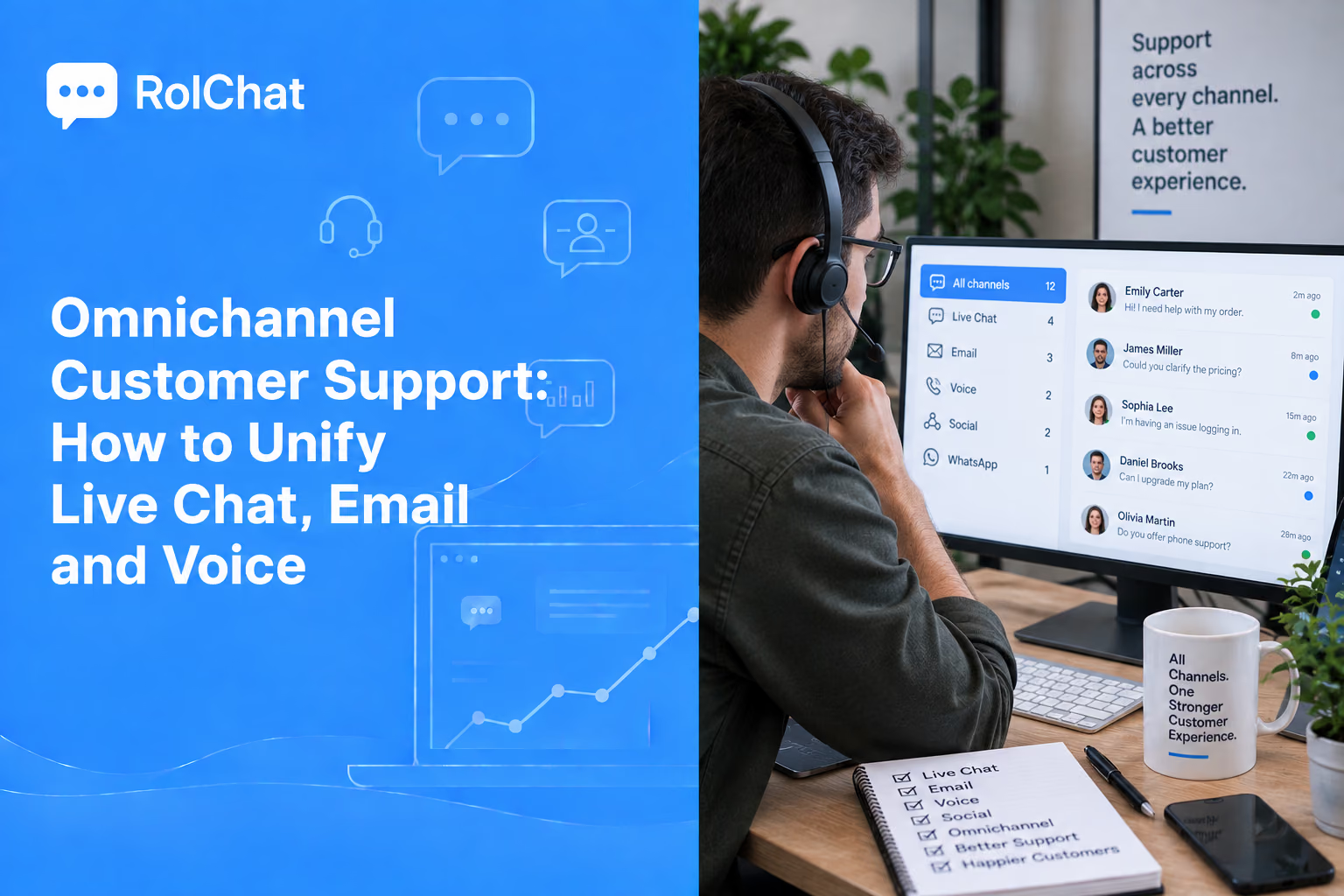
Customers rarely stay on one channel. A question starts in the website chat, continues by email, moves to WhatsApp and ends on the phone when it turns urgent. Omnichannel contact center software is what keeps those four contacts as one conversation instead of four unrelated tickets.
The distinction is not cosmetic. It decides whether your customer repeats the order number four times, and whether your agent answers with the account history in front of them or without it.
What omnichannel contact center software has to do
Multichannel means you are reachable in several places. Omnichannel means those places share one record. Most tools that advertise the second are delivering the first.
Three capabilities separate them, and all three are worth testing in a trial rather than reading on a feature page.
The first is a single queue: every channel lands in one place with one set of rules, not in one tab per channel. The second is identity: contacts arriving on different channels resolve to the same person. The third is continuity: history follows the customer across channels, including across a handoff to a colleague.
Open a chat, reply to the same customer by email, then call them. If the agent handling the call can read the chat and the email without leaving the conversation, the platform is omnichannel. If not, it is multichannel with good marketing.
Scattered channels and the cost of re-asking
The cost of split channels does not show up as an outage. It shows up as repetition, duplicated work and answers that contradict each other.
Repetition is the part customers notice. Every channel switch that starts from nothing asks them to restate the problem, and each restatement is a chance to give up.
Duplicated work is the part the team notices. Two agents answer the same question from two tools because neither can see the other's reply, and the second answer arrives after the customer has already acted on the first.
Contradiction is the expensive one. When a chat says one thing and an email says another, the resolution is no longer about the original issue.
Worth counting before you change anything: how many conversations touch more than one channel. That number is the size of the problem.
One shared inbox, and what belongs in it
The shared inbox is the core of the setup, and its value comes from what it refuses to leave outside.
RolChat brings 11 channels into one place: web chat, email, phone, SMS, WhatsApp, Telegram, Facebook Messenger, Instagram, Viber, LINE and web forms. The number matters less than the fact that they arrive under the same rules.
One queue means one routing model, one set of roles, one place where history lives and one definition of what counts as answered.
That last item is the one teams underestimate. When each channel has its own idea of closed, no report about resolution time means anything across the whole team.
Identity: the part that makes it one thread
Joining channels is easy. Joining people is the hard part, and it is where shared team inbox tools quietly differ.
Each channel offers a different identifier. Email gives an address, WhatsApp a phone number, Instagram a handle, web chat often nothing at all until the visitor types something.
| Channel | Identifier it supplies | Matches on its own |
|---|---|---|
| Address | Yes | |
| Phone and SMS | Number | Yes |
| WhatsApp and Viber | Number | Yes |
| Telegram and LINE | Platform handle | Only after a first link |
| Instagram and Messenger | Platform handle | Only after a first link |
| Web chat | Session, sometimes an email | No |
The rows that say no are the ones that decide the project. A platform that cannot merge a handle to a known contact will show two records for one person, and every report built on top of it will double-count.
Ask how merging works, whether an agent can do it during a live conversation, and whether merged history stays merged after the customer returns on a third channel.
Routing rules that survive a busy day
Routing is where an omnichannel setup either saves time or creates a new queue to manage.
The rules that hold up are the boring ones: by topic, by language, by plan tier, by whether the customer already has an open conversation. That last rule prevents the most common failure, where a returning customer is routed to a new agent while the original one is still working the case.
Skills-based routing works when the skills are few and real. A list of twenty skills maintained by nobody becomes a lottery within a quarter.
Priority deserves the same restraint. Two levels that people respect beat five levels that everyone marks as highest.
Route to the person who already handled this customer before routing by skill or availability. Continuity beats matching, and it costs nothing to configure.
Channels differ, and the differences matter
Treating every channel identically is the second most common mistake, after treating them separately.
Messaging channels carry their own delivery rules and message windows set by the platform owner, not by your helpdesk. A reply that is fine at four minutes may be blocked at forty hours.
Email tolerates length and formatting; chat does not. The same answer that reads well in an email arrives in chat as a wall nobody finishes.
Social channels are public until they are not. A comment answered in public and a complaint answered in a private message are different tasks with different reviewers.
Good omnichannel software normalises the plumbing and leaves the register alone, so an agent writes appropriately for the channel without learning six interfaces.
Voice inside the same workspace
Voice is the channel most often left outside, usually because it arrived from a different vendor and stayed there.
Keeping it outside costs more than it looks. The call is where the difficult cases go, so the channel with the most context ends up with the least, and the transcript never reaches the record the rest of the team reads.
Inside one workspace, a call opens the same customer record, its transcript lands on the same thread, and a follow-up email continues from it rather than starting over.
Call minutes are billed apart from the plan, so voice volume stays a line you can see rather than a hidden component of a seat price.
Handoffs between channels without a restart
Most omnichannel value is realised at the moment of a handoff, and most omnichannel disappointment is too.
A handoff done well carries three things forward: what the customer asked, what was already promised, and what has been checked. Without the middle item, the second agent re-promises or contradicts.
Channel switches initiated by your team need the same care. Moving a chat to a call because it is faster only helps when the call opens with the chat visible.
Best test in a trial: hand a live conversation to a colleague on a different channel and count how many questions the customer is asked twice.
Where AI fits into an omnichannel setup
AI is more useful once channels are already joined, because a model that can see one channel writes from one channel.
With a single record behind it, the assistant drafts from the full history, translates in both directions across 40 languages, and classifies intent on arrival so routing runs before a human reads anything.
The order is worth respecting. Automation applied to fragmented channels produces confident answers based on a third of the story.
Measuring whether the channels are really unified
Per-channel dashboards will show green while the experience is broken, because each channel measures only its own slice.
Four measures read across the seam. Share of conversations touching more than one channel. Time to resolution for those, compared with single-channel ones. Repeat contact rate within a week. Duplicate contact records created per month.
The gap between multi-channel and single-channel resolution time is the single most honest number in the set. As the setup improves, the gap narrows.
Duplicate records are the leading indicator. When that count climbs, identity matching is failing, and every other number will follow it down.
Migration order that does not break the queue
Moving every channel on the same day is how teams end up rolling back.
A sequence that holds: start with the channel carrying the most volume and the least complexity, usually email or web chat. Run it alongside the old tool for a week with routing rules copied rather than reinvented.
Add messengers next, because they surface identity problems early and cheaply. Move voice last, since it has the most external dependencies and the least tolerance for a bad week.
History import belongs in the first step, not the last. Agents will not trust a workspace that starts empty, and they will keep the old tab open, which defeats the whole exercise.
Limits worth knowing before you buy
Pricing is per company rather than per agent, from $19 on Lite, with Enterprise priced on request, so adding a channel does not multiply by headcount.
Telephony and consent are paid add-ons, and add-ons are not available on Lite. Consent runs at $5 per site with three consents per site.
On-premise deployment is an Enterprise arrangement, and models running on your own hardware are planned rather than available today.
The trial runs 30 days with every feature open and a card on file, which is long enough to test identity matching on real traffic rather than on a demo account.
Frequently asked questions
What does omnichannel contact center software actually change?
It puts every channel into one queue behind one customer record, so history follows the person rather than the channel. The visible result is that customers stop repeating themselves after a channel switch.
How is omnichannel different from multichannel?
Multichannel means you are reachable in several places. Omnichannel means those places share one record and one set of routing rules. Many tools sold as the second deliver the first.
Which channels should be unified first?
The highest volume and lowest complexity first, usually email or web chat, then messengers, then voice. Voice has the most external dependencies, so it benefits from going last.
How do conversations from different channels get joined?
By identity matching. Email and phone numbers match on their own, platform handles usually need a first link to a known contact, and web chat sessions often supply nothing until the visitor identifies themselves.
Does voice belong in the same platform as chat?
Calls carry the hardest cases, so leaving voice outside means the channel with the most context has the least. In one workspace the transcript lands on the same thread as the chat and the email.
What should be measured after unifying channels?
Share of conversations touching more than one channel, resolution time for those against single-channel ones, repeat contact rate within a week, and duplicate contact records created per month.
How many languages does it cover?
40 for the interface and the widget, with translation in both directions inside a conversation. Keep product and legal terms in a glossary so they are not translated.
Is the pricing per agent?
It is per company, from $19 on Lite, with Enterprise priced on request. Telephony and consent are add-ons, and add-ons are not sold on Lite.

Writes about customer support operations, live chat, AI-assisted service and the tooling behind great customer experience.
LinkedIn